What Is a Back End?
A back end (also written backend) is the server-side part of a website or application: the servers, application code, and databases that process requests and manage data behind the interface. It receives requests from the front end, the part users see and interact with, and returns data, content, or results.
More About Back Ends
The back end is the part of a website you use constantly but never see. Every login, search, and checkout is handled there: the front end collects what you type, and the back end does something with it. You'll see the term written three ways: back end (noun), back-end (adjective, as in back-end developer), and backend (one word, common in technical documentation).
How the back end works
The back end answers requests. Say you log in to a website: your browser sends your username and password to the server, the computer that hosts the site. Application code running on that server checks your credentials against a database, where the site keeps its stored data. If they match, the code builds the next page and sends it back to your browser, or returns raw data as JSON through an API for the front end to display. That round trip may take a fraction of a second, or it may stall when the server, database, network, or an external service is slow. Either way, the work itself stays hidden: you only ever see the page that comes back.
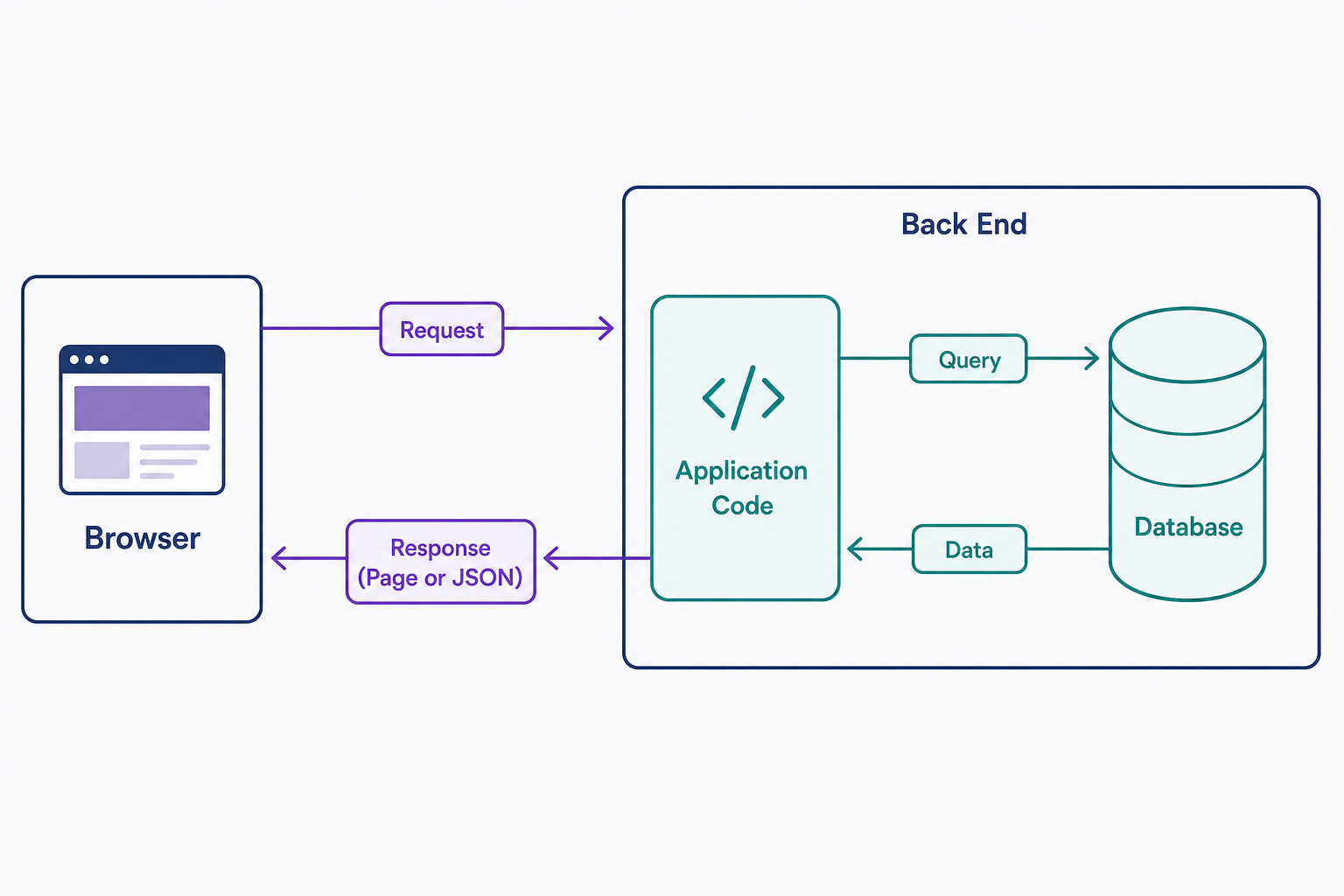
Back end vs. front end
The front end is everything users see and interact with in the browser. The back end is everything running on the server to make those interactions work. The split looks like this:
- Where the code runs: back-end code runs on the server; front-end code runs in the visitor's browser.
- What users see: none of the back end and all of the front end (layout, text, buttons, forms).
- Typical languages: PHP, Python, Java, and Ruby on the back end; HTML, CSS, and JavaScript on the front end.
- What failure looks like: a broken back end shows 500 errors, failed logins, or lost orders; a broken front end loads the page but displays it wrong.
Common back-end languages and frameworks
If you run a WordPress site, you already run a back end: WordPress is written in PHP and keeps every post, page, and setting in a MySQL or MariaDB database. WordPress.org's current requirements recommend PHP 8.3 or greater and MariaDB 10.11+ or MySQL 8.0+.
- Common back-end languages: Java, PHP, Python, Ruby, C#, and Go. JavaScript also runs on the server through the Node.js runtime.
- Popular back-end frameworks: Django and Flask (Python), Laravel (PHP), Rails (Ruby), and Express (Node.js). A framework is prewritten scaffolding, so developers don't rebuild routing, security, and database access from scratch.
Why the back end matters for your website
Back-end problems are what your visitors experience as broken pages. A crashed server-side process is a 500 error. A slow database query is a page that hangs. A dropped connection to a payment API is an abandoned checkout. The code is invisible; the symptoms never are.
Not every site needs a custom back end, though. A static informational site, where every visitor sees the same pages, can be served as plain files, with third-party services covering isolated jobs like a contact form. You do need a back end when your site must sign users in, store data that changes, process payments, keep secrets such as API keys off the browser, or run logic visitors shouldn't be able to tamper with.
The back end is also exactly what your hosting runs: your plan supplies the server that executes your application code and database. If your site runs WordPress, keep PHP and your database on supported versions, or choose a hosting plan that handles those updates for you. WordPress will still run on PHP 7.4, but wordpress.org warns that version has reached official end of life and may expose your site to security vulnerabilities. Check which PHP version your site runs today; it takes a minute and it's the fastest health check your back end has.
Frequently Asked Questions
- Both. In the browser, JavaScript is front-end code that makes pages interactive. Run through the Node.js runtime, the same language also works on the server as back-end code. Node.js itself isn't a language; it's the environment that runs JavaScript outside the browser.
- A back-end developer builds and maintains the server side of an application: writing the logic that handles requests, designing databases, connecting APIs, and keeping everything secure and fast under load. Front-end developers handle what users see; back-end developers make sure it works.
- A full-stack developer works on both sides of an application: the front end users see and the back end that powers it. One full-stack developer can build a feature end to end, from the database to the browser.
Web Hosting
Our Web Hosting plans offer a user-friendly interface and flexible options to fit your needs, with a 30-Day Money-Back Guarantee.
Web Hosting Plans