What is the Google Knowledge Graph?
The Knowledge Graph is Google’s database of billions of facts about real-world entities: people, places, organizations, and creative works, plus the relationships between them. Google uses it to answer factual questions directly in search results and to fill the knowledge panels that appear beside them.
More about the Google Knowledge Graph
Google’s Knowledge Graph is the company’s database of real-world entities and the relationships that connect them. It covers people, places, organizations, and creative works like movies and books. Google launched it on May 16, 2012, under the banner of “things, not strings”: instead of treating your query as a string of keywords to match, Google recognizes the things you’re asking about.
That makes it a separate system from Google’s search index, which catalogs web pages. The index answers “which pages mention this?” The Knowledge Graph answers “what is this, and how does it relate to that?” In a May 2020 explainer, Google put the graph’s size at more than 500 billion facts about 5 billion entities.
You see the Knowledge Graph at work whenever Google answers a factual question on the spot. Google’s own example is “How tall is the Eiffel Tower?”: the answer appears at the top of the search results, no click required. It also fills the info boxes you see when you search for a company, showing details like its founding date, logo, and headquarters.
Where the Knowledge Graph gets its data
Google names its inputs in the help page How Google’s Knowledge Graph works, with more detail in the May 2020 explainer:
- Public sources such as Wikipedia. The 2012 launch announcement also credited Freebase and the CIA World Factbook.
- Licensed data for facts like sports scores, stock prices, and weather forecasts.
- Health content that Google described in May 2020 as created and vetted with medical providers.
- “Special coding,” Google’s term for structured data that content owners add to their pages, such as marking up upcoming events.
- Suggested changes from people and businesses that have claimed their knowledge panels.
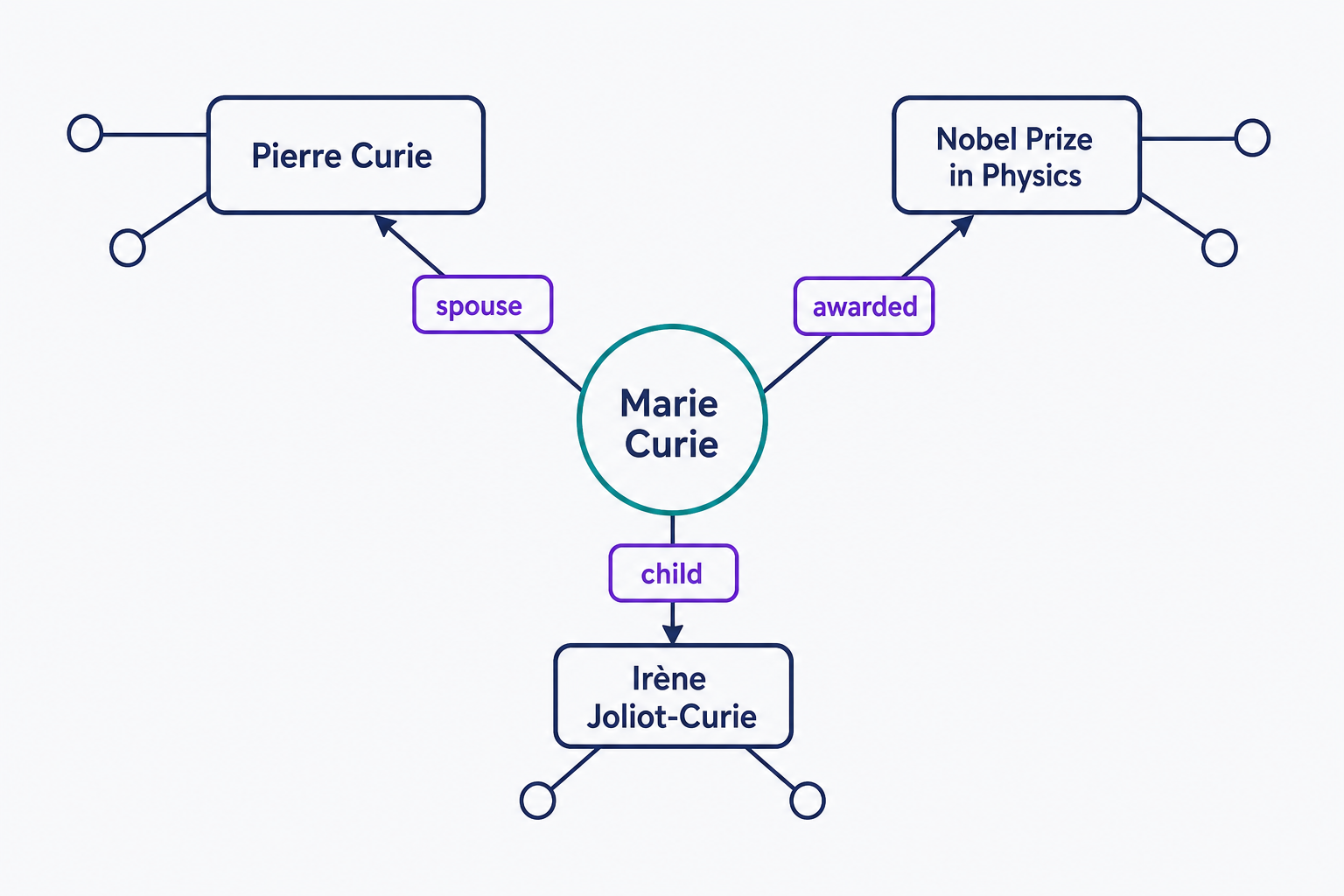
What makes it a graph rather than a list is that it stores the connections, not just the facts. In Google’s launch example, Marie Curie links to her Nobel Prizes, her husband Pierre, and her children, and each of those entities links onward to facts of its own.
Knowledge Graph vs. knowledge panel
People often use the two names interchangeably, but one feeds the other:
- The Knowledge Graph is the back-end database of facts about entities. Searchers never see it directly.
- A knowledge panel is the visible info box beside search results, filled automatically with facts pulled from the graph.
In short, the graph stores and the panel displays. Direct answers at the top of results draw on the same database.
How to get into the Knowledge Graph
There’s no submission form. Google has to recognize you as an entity, and you build that recognition with consistent, machine-readable evidence:
- Add schema markup to your site so crawlers can read your organization’s name, logo, founders, and official profiles as structured data.
- Establish yourself on the sources Google draws from: a Wikidata entry, a Wikipedia article if you meet its notability standards, and matching details on every official profile.
- For a local business, create and verify a Google Business Profile. That gives you a local panel of its own, powered by your profile rather than by the Knowledge Graph.
- Once a knowledge panel appears, claim it and get verified so you can suggest changes directly.
Our guide to entity SEO walks through each step in detail.
Why the Knowledge Graph matters for SEO
Entities in the graph can earn knowledge panels and direct answers, which gives you a say in how your brand appears on its own results page, and a verified panel lets you correct what searchers see.
The trade-off is real: graph-powered answers are zero-click. When Google states a fact at the top of the page, the site that used to earn that visit often doesn’t get it, so pages built on facts Google can answer inline tend to lose traffic. Entity data also feeds AI-generated answers, which raises the stakes of being represented accurately. Search your brand name today; if the panel is wrong or missing, start with schema markup and consistent profiles.
Frequently Asked Questions
- Claim and get verified for your knowledge panel, then suggest changes directly to Google. Anyone can also select Feedback at the bottom of a panel (or the three-dot menu on mobile). Google removes demonstrably false or outdated facts, prioritizing civic, medical, scientific, and historical topics.
- Google launched the Knowledge Graph on May 16, 2012, with about 500 million entities and 3.5 billion facts. By May 2020 it had grown to more than 500 billion facts about 5 billion entities, the most recent count Google has published.
- No. A knowledge graph, lowercase, is any database of entities and the relationships between them; Google Cloud even offers an Enterprise Knowledge Graph product for companies building their own. In SEO, though, ‘the Knowledge Graph’ almost always means the one behind Google Search.
- Query Google’s Knowledge Graph Search API, which returns matching entities as JSON-LD with schema.org types. A match proves you’re in the graph, though not that a panel will display. On a brand search, an entity panel signals inclusion, but local panels with hours and reviews come from Google Business Profile.
Professional SEO Services
Our Pro Services team will help you rank higher and get found online. Let us take the guesswork out of growing your website traffic with SEO.
SEO Services