What is Information Retrieval?
Information retrieval (IR) is the process of finding material, usually documents or web pages, that satisfies an information need within a large collection. Search engines are information retrieval systems: when you enter a query, the engine searches its index and ranks the most relevant pages in the results.
More About Information Retrieval
Every web search is an information retrieval task. When you hit enter, the engine doesn’t read the live web; it looks up a pre-built index of pages it has already collected and returns the ones its systems score as most relevant to your query.
How search engines retrieve information
Search engines run automated IR at enormous scale, and Google documents the process in 3 stages:
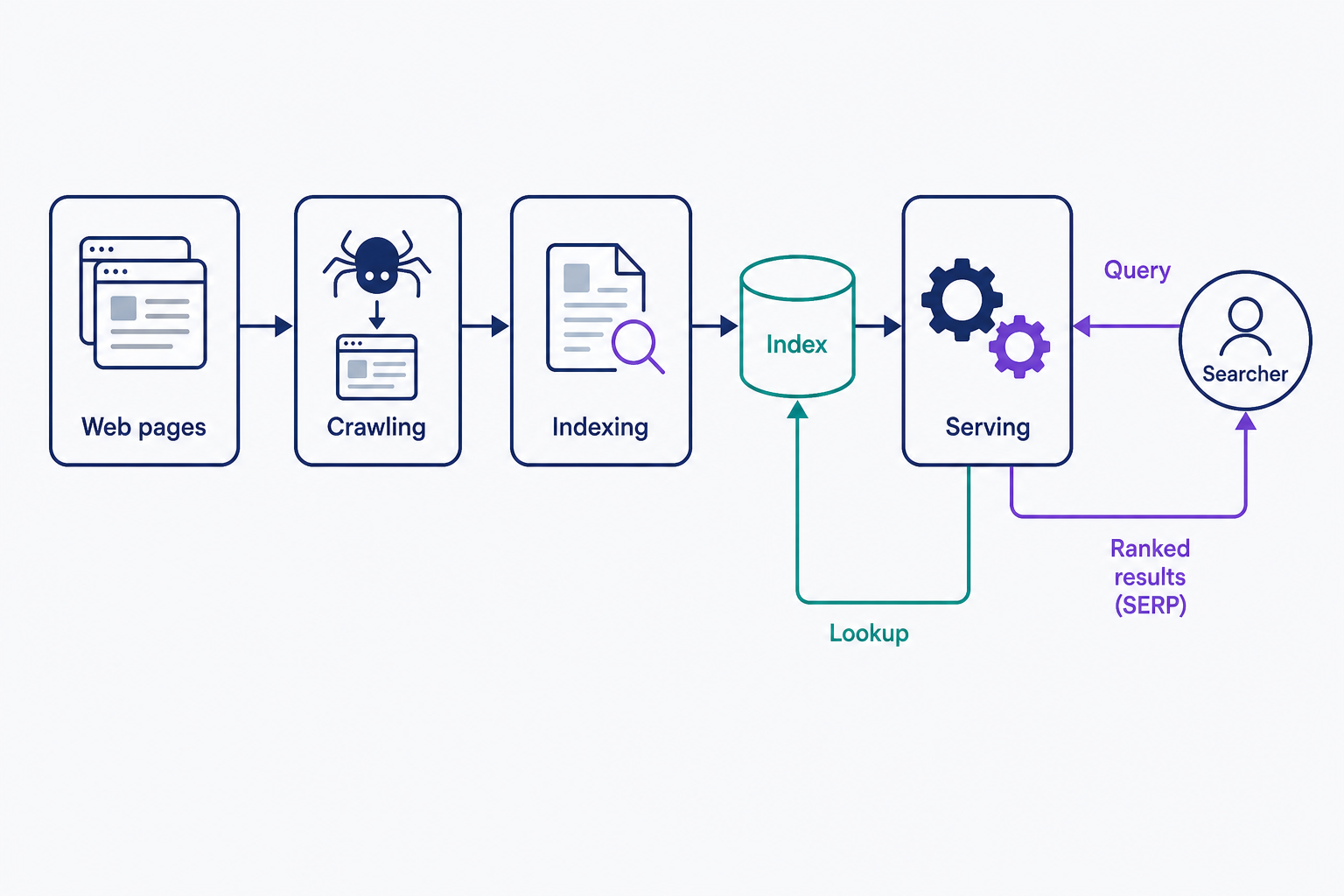
- Crawling: crawlers like Googlebot follow links across the web and fetch pages ahead of time, before anyone searches.
- Indexing: the engine analyzes each fetched page and stores it in the index, the lookup structure every later search runs against.
- Serving: when a query arrives, the engine’s ranking systems look up matching pages in the index and order them in the search engine results pages (SERPs) by relevance signals, including the words of the query, content freshness, usability, and the searcher’s location and language.
Underneath, an information retrieval system matches the query against its collection using a retrieval model. The standard textbook, Introduction to Information Retrieval (Cambridge University Press, 2008), describes the two classic models, Boolean and ranked retrieval; modern engines add a newer third approach, semantic retrieval:
- Boolean matching returns documents that contain the query terms, yes or no, with no ranking. It’s the oldest model.
- Ranked retrieval scores every document by relevance, using statistical formulas such as TF-IDF and BM25 that weight how often and where terms appear, and returns the best candidates first.
- Semantic retrieval matches meaning rather than exact words, so a query for “cheap flights” can retrieve a page about “low-cost airfare.”
Examples of information retrieval systems
Web search is the biggest example, but far from the only one. A store’s on-site product search, the search box in your email client, and a library catalog are all IR systems: each takes a query, searches a collection, and returns a ranked list of likely matches.
Take the query “renew domain.” An IR system splits it into terms (tokenizes it), looks up which indexed documents contain those terms, scores each match by relevance, and returns a ranked list, with a help page titled “How to renew your domain” probably near the top.
Information retrieval vs. data retrieval
Information retrieval searches unstructured content and ranks results by relevance; data retrieval queries structured data for exact matches. An IR system doesn’t guarantee an exact “match” or a single “correct” answer. It hands you ranked possibilities and lets you pick.
- Information retrieval: searches unstructured content like web pages, tolerates partial matches, and returns a ranked list. A Google search for “best running shoes” is IR.
- Data retrieval: queries a structured database and returns exact records or nothing. An SQL query fetching order #4571 either finds that row or fails; there’s no “close enough.”
Why information retrieval matters for SEO
Your page can only be retrieved if it was crawled and indexed first, and it’s only retrieved for queries whose words and meaning match your content. Every ranking you earn or miss starts with that index lookup.
So write with retrieval in mind: use the terms your audience actually types, keep pages crawlable and indexable (no accidental noindex tag, no blocked robots.txt), and check the indexing report in Google Search Console to confirm your pages made it in.
Retrieval-based AI search starts from an index, too. Google’s AI features documentation says standard SEO best practices remain relevant for AI Overviews and AI Mode, with no additional requirements to appear in them. Other AI products set their own crawling and indexing rules, so check each platform’s documentation for crawler access before counting on citations. Our guide to what small businesses get wrong about AI search covers that side.
Frequently Asked Questions
- Mainly with precision and recall. Precision is the share of retrieved results that are relevant; recall is the share of all relevant documents the system actually retrieved. A system tuned only for precision misses answers; one tuned only for recall buries them in junk.
- It depends on the product. Web-grounded AI search features retrieve indexed pages, then generate an answer from them (retrieval-augmented generation); other tools answer from model knowledge alone. Google says standard SEO is all AI Overviews require, and each platform sets its own crawling and indexing rules.
- No. Information retrieval finds relevant documents within a large collection, while information extraction pulls structured facts, like names and dates, out of a document you already have. A search engine retrieves pages; an extraction tool reads one page and pulls data from it.
Professional SEO Services
Our Pro Services team will help you rank higher and get found online. Let us take the guesswork out of growing your website traffic with SEO.
SEO Services