What is an External Link?
An external link, also called an outbound link, is a hyperlink that points from a page on one website to a page on a different domain, while internal links connect pages on the same site. Outbound links aren’t a known direct ranking factor, but backlinks (external links pointing to a site) do influence its rankings.
More About External Links
External links let you cite evidence, credit your sources, and send readers to documentation or further reading. Which direction a link points, out from your site or in toward it, decides whether it affects rankings.
External links vs. internal links
An internal link connects pages on the same website; an external link leaves the site entirely. Both belong in a complete SEO plan. Internal links guide visitors deeper into your site and can reduce your bounce rate, while external links connect your claims to sources readers can check.
External links vs. backlinks
The same hyperlink gets a different name depending on which end you're standing on:
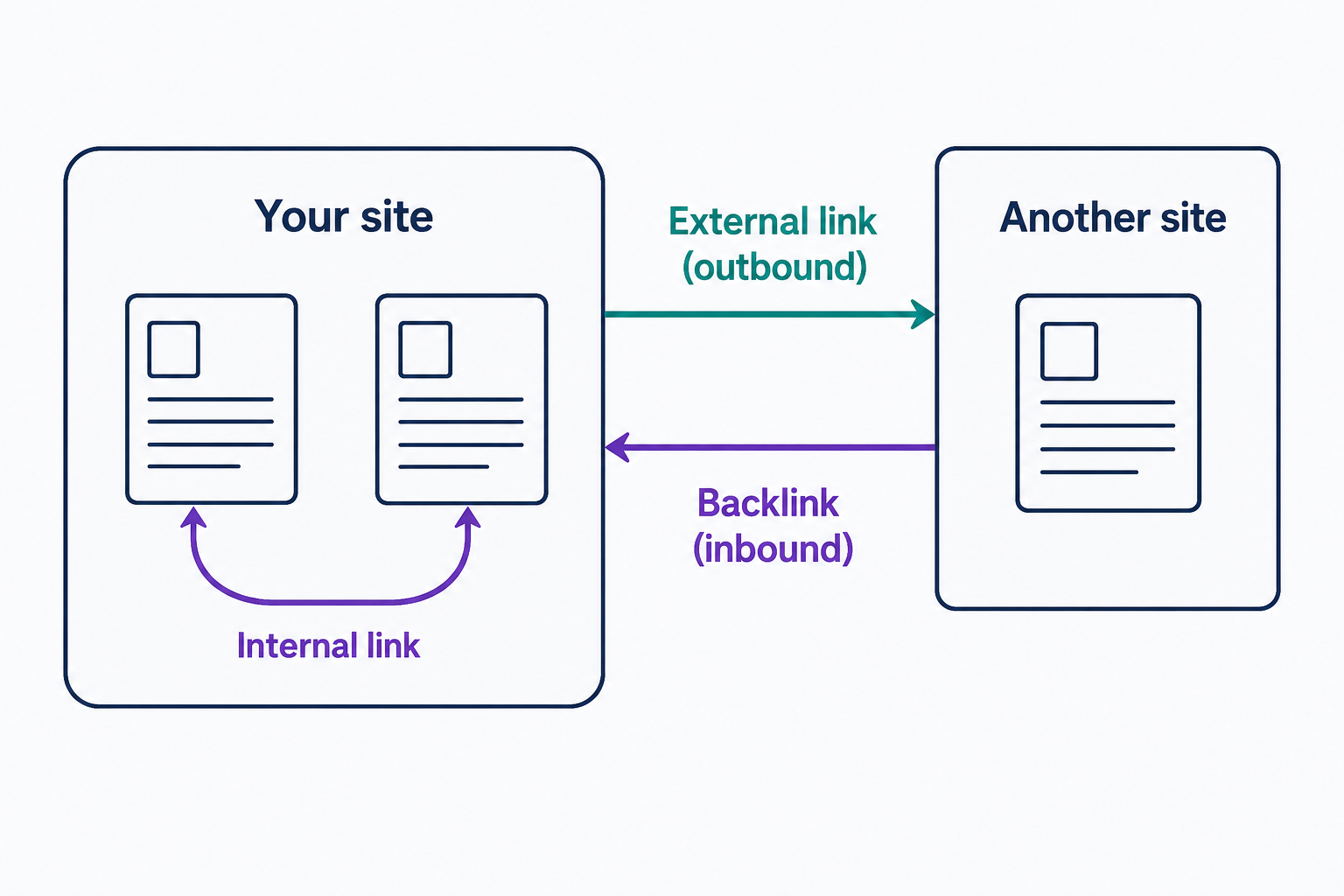
- An outbound external link points from your page to a page on another domain. It adds credibility and context for readers, but it isn't a direct ranking factor.
- A backlink, also called an inbound link, is an external link on someone else's site that points to your site. Backlinks can influence how a page ranks, but their relevance and quality matter far more to Google than their raw number.
When an SEO guide calls links a ranking signal, it means backlinks. Earning them is a separate discipline called link building.
External links and search rankings
Linking out gives your page no known direct ranking boost; Google's documentation promises no rankings reward for ordinary editorial links. The links its systems evaluate point the other way. Google's guide to ranking systems describes link-analysis systems, including PageRank, that read how pages link to each other to work out what pages are about, and its How Search Works pages name links from other prominent websites as one factor in judging quality. Ranking credit flows to the page being linked to, not from the page doing the linking.
Linking out won't build your domain authority either. Moz calculates that score from backlink data: the links pointing at your site, not the ones you send out.
What outbound links do earn is reader trust, and "reputable" means something concrete: prefer the primary source over a blog summarizing it, prefer official documentation over forum threads, and confirm the target page still loads before you link to it.
Adding an external link in HTML
An external link is a standard anchor tag whose URL points at another domain:
<a href="https://example.com/study" target="_blank" rel="noopener">the 2026 study</a>
The clickable words are the link's anchor text, and they should describe the destination. Google's outbound link guidance explains when to qualify a link with a rel attribute:
rel="sponsored": for advertisements and paid placements.rel="ugc": for links in user-generated content, such as blog comments.rel="nofollow": when you don't want to vouch for the page you're linking to. The nofollow attribute entry covers the details.- No rel attribute at all: for ordinary editorial links, which is most of them.
When external links go wrong
External links rot. Target pages move or get deleted, and every broken link left behind frustrates readers and erodes the trust the link was meant to build. Linking to low-quality or spammy sites does the same damage faster, and a paid link left unqualified, with neither rel="sponsored" nor rel="nofollow", violates Google's spam policies.
The fix is routine: audit your outbound links a few times a year, then repair or remove the dead ones. Our guide to finding and fixing broken links walks through how to do it.
Frequently Asked Questions
- It's a user-experience choice, not an SEO factor. If you use target="_blank", add rel="noopener" so the new page can't access the page that opened it. Many publishers open external links in new tabs to keep visitors on the original article.
- There's no fixed number. Link out wherever a citation or resource genuinely helps the reader, and judge each target by quality rather than counting links. A well-researched article might carry a dozen external links; a simple product page might need none.
- Either works. Google prefers rel="sponsored" for paid and advertising links, but its documentation says nofollow is still an acceptable way to flag them, so paid links already marked nofollow comply and don't need to be rewritten.
Professional SEO Services
Our Pro Services team will help you rank higher and get found online. Let us take the guesswork out of growing your website traffic with SEO.
SEO Services