What Is an SLA (Service Level Agreement)?
A service level agreement (SLA) is a documented agreement between a service provider and a customer that sets measurable service targets, such as uptime percentage and support response time, along with how they’re measured and each party’s responsibilities. Customer-facing SLAs are usually written into the service contract and often promise remedies, typically service credits, when targets are missed.
More About SLAs
An SLA is a standard part of ongoing service arrangements, especially in technology: web hosting, cloud, telecom, and IT support contracts commonly include one. A one-off purchase doesn't need an SLA. A service you depend on month after month does.
What separates an SLA from a generic service agreement is measurability. It defines specific service levels, like an uptime percentage or a support response time, states how each one is measured, and spells out what happens when a level is missed. Customer-facing SLAs are usually part of the service contract and typically back their targets with service credits; internal SLAs between teams set the same expectations without the legal wrapper. Either way, a written SLA keeps both sides from interpreting the service terms differently, deliberately or not.
What a hosting SLA covers
Most hosting SLAs have 5 standard parts:
- Scope: which services are covered, such as the hosting plan itself, email, or support.
- Service levels: the measurable commitments, most often an uptime percentage and a support response time.
- Measurement: how each level is calculated and over what period, usually per calendar month.
- Remedies: what you receive when a level is missed, typically service credits: a partial refund or free service time rather than cash.
- Exclusions: downtime that doesn't count, such as scheduled maintenance, outages you cause, and events outside the provider's control.
In a customer-facing SLA, the remedies clause is what gives the targets teeth: a promise with a penalty attached. If a host's promise has no number and no remedy behind it, treat it as marketing, not a service level.
The downtime math behind uptime percentages
An uptime percentage is a cap on allowed downtime, and small-looking decimals hide big differences. Assuming round-the-clock operation, the SLA calculator uptime.is puts the allowances at:
- 99.9% uptime: 43 minutes 50 seconds of downtime allowed per month, or 8 hours 45 minutes per year.
- 99.99% uptime: 4 minutes 23 seconds per month, or 52 minutes 36 seconds per year.
- 100% uptime: no qualifying downtime allowed at all. No host avoids downtime entirely, so the value is in the credit policy: whether an interruption actually earns a credit still depends on the SLA's exclusions, monitoring method, claim deadline, and remedy cap.
Here's why the math matters. Say your host goes down for 6 hours in one month. With no SLA, you have no defined recourse. Under a 99.9% SLA, that one outage is roughly 8 times the monthly allowance, so unless the downtime falls under an exclusion, it's a breach and the agreed credit is owed.
When your host breaks the SLA
The standard remedy is service credits, not damages. You get part of your fee back or extra service time; lost sales during the outage aren't covered. Many providers also pay out only if you file a claim within a set window, so read the claims process before you need it, and remember that excluded downtime, like scheduled maintenance, never counts as a breach.
As a hosting customer, your host's SLA is where the uptime guarantee lives. DreamHost's General Terms of Service (last updated June 22, 2026) guarantee 100% uptime: if your service is interrupted, we credit your account a day of hosting for each hour, or fraction of an hour, of the interruption. When you compare hosting providers, weigh the remedy, not just the headline percentage.
SLA vs. SLO vs. SLI
The 3 terms sit at different layers of the same measurement. The distinction comes from Google's site reliability engineering team, laid out in its SRE fundamentals post (July 19, 2018):
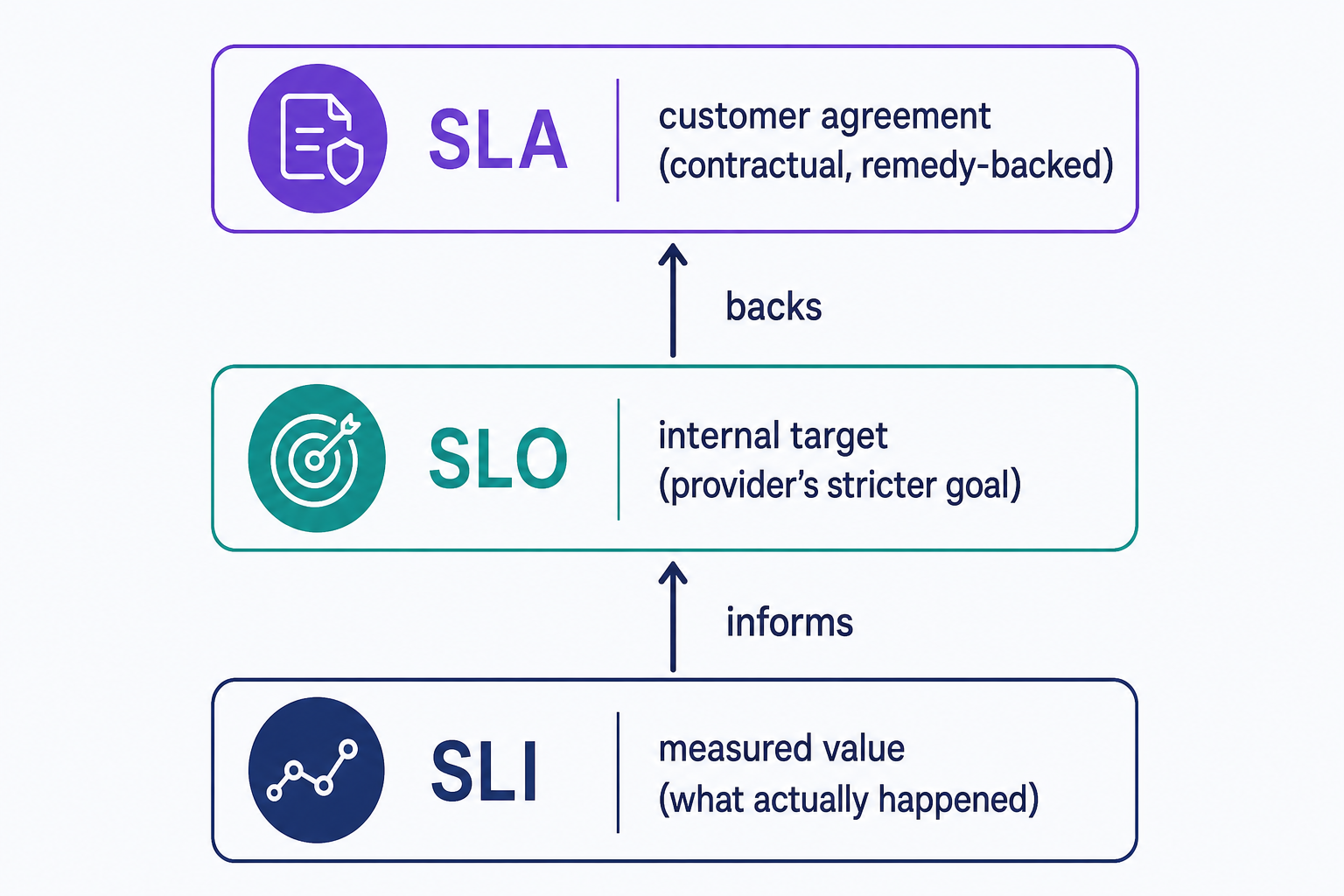
- SLA (service level agreement): the customer-facing agreement, usually contractual and penalty-backed. Miss it and the provider owes the agreed remedy.
- SLO (service level objective): the provider's internal target, usually stricter than the SLA to leave a buffer. A contractual 99.9% might be backed by an internal 99.95%.
- SLI (service level indicator): the measured value itself, such as observed uptime or latency, that shows whether the target is being met.
If you sell ongoing services yourself, such as site maintenance or support retainers, write your own SLA. Google's SRE guidance is blunt: "If you're charging your customers money, you will probably need an SLA." Use the 5 parts above as your checklist. Put a number on every promise, and cap the remedy.
Frequently Asked Questions
- Not always. An SLA is legally binding only when it forms part of an enforceable contract, like the terms you accept when buying a hosting plan; local contract law governs the rest. Internal or operational SLAs between teams carry no legal force, and remedies are usually capped at service credits.
- Some inexpensive plans include an SLA and others don't, so check before you buy. DreamHost's 100% uptime guarantee, for example, is in our standard Terms of Service, not a premium add-on. Verify 4 things: what's covered, what's excluded, how credits are calculated, and whether you must file a claim.
- The provider drafts it, and most customers accept it unchanged. Enterprise customers with negotiating power can push for stricter targets or bigger credits. If you resell hosting, write your own SLA rather than passing your provider's promises straight through to your clients.
Web Hosting
Our Web Hosting plans offer a user-friendly interface and flexible options to fit your needs, with a 30-Day Money-Back Guarantee.
Web Hosting Plans