What is an sTLD?
A sponsored top-level domain (sTLD) is a top-level domain run by a sponsor organization that represents the specific community the TLD serves and sets eligibility rules for who can register. Examples include .gov (US government), .edu (US higher education), and .aero (air transport). ICANN delegates policy-making authority to the sponsor.
More About sTLDs
sTLDs serve defined communities, not brands. Every sTLD has a sponsor: an organization that represents the community the domain serves and sets the rules for who can register, under authority delegated by ICANN. Generic top-level domains (gTLDs) work differently: many, like .com and .org, are open to anyone who wants to register a domain name, though some gTLDs are restricted or are closed brand registries.
Brand TLDs such as .google and .apple are often mistaken for sTLDs, but IANA's root zone database classifies both as generic TLDs. Each belongs to a single company rather than to a sponsored community.
Where sTLDs fit among TLD types
IANA, which maintains the root zone of the Domain Name System (DNS), groups TLDs into three main categories: generic (gTLD), sponsored (sTLD), and country-code (ccTLD), plus the infrastructure TLD .arpa. A country-code top-level domain (ccTLD) is a two-letter extension tied to a country or territory, such as .uk or .de.
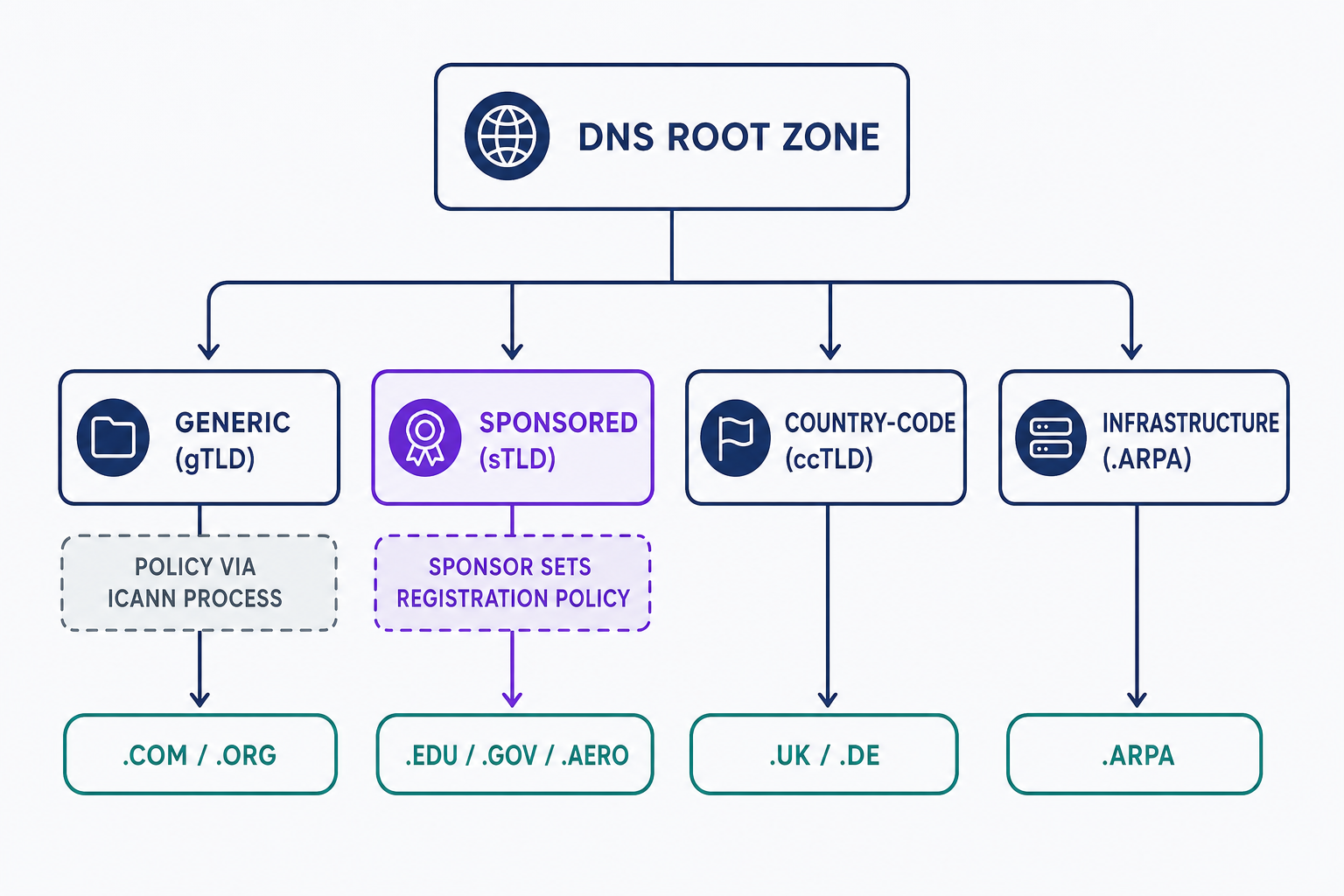
The sponsored and unsponsored categories differ in who sets policy. An sTLD's sponsor writes and enforces its registration rules under authority delegated by ICANN, while unsponsored gTLDs follow policies made directly through the ICANN process. Both operate under agreements with ICANN, so neither type sits outside its oversight. For the full map of TLD types, see our domain extension entry.
Current sTLDs and their sponsors
IANA's root zone database currently lists 9 sponsored TLDs:
- .aero: sponsored by SITA for the air-transport industry
- .asia: sponsored by the DotAsia Organisation for the Asia-Pacific community
- .coop: sponsored by DotCooperation LLC for cooperative associations
- .edu: sponsored by Educause for accredited US postsecondary institutions
- .gov: sponsored by the Cybersecurity and Infrastructure Security Agency (CISA) for US federal, state, and local government
- .int: sponsored by IANA itself for organizations created by international treaty
- .jobs: sponsored by Employ Media LLC for the human-resources community
- .mil: sponsored by the DoD Network Information Center for the US military
- .post: sponsored by the Universal Postal Union for postal services
Six TLDs that launched as sponsored later converted to standard gTLD registry agreements: .cat, .mobi, .museum, .tel, .travel, and .xxx. IANA no longer lists them in the sponsored category.
Who can register an sTLD domain
You can register a domain on an sTLD only if you belong to its sponsored community and pass the sponsor's eligibility check. Educause verifies that a .edu applicant is an accredited US postsecondary institution. CISA verifies that a .gov applicant is a genuine US government organization. If you don't qualify, the application is refused, and paying more won't change that. Your option is an open gTLD like .com instead.
Watch the scope, too: .edu and .gov eligibility is specific to the United States. Other countries typically handle education and government sites under their own ccTLDs, such as .ac.uk or .gouv.fr. If you're weighing which extension fits your project, our guide to choosing a domain extension walks through the trade-offs.
What an sTLD signals
Because the sponsor verifies eligibility before a domain is issued, the extension works as an identity signal: a .gov domain belongs to a verified US government organization, and a .edu domain to an accredited US school. If you qualify, the extension vouches for who you are. If you don't, you can't buy your way in at any price.
That signal has limits. It confirms who registered the domain, not that the site is safe: a verified organization's pages can still be misconfigured or compromised, and the strength of the check depends on each sponsor's verification and enforcement rules. Some restricted gTLDs verify their registrants too. Before you trust any site, read the exact hostname (cisa.gov, not cisa-gov.com) and check the usual security signals, such as a valid HTTPS certificate.
No new sTLDs are being created
ICANN used the sponsored designation in just two application rounds. The 2000 round produced .aero, .coop, and .museum, and a second round that closed in March 2004 added .asia, .cat, .jobs, .mobi, .post, .tel, .travel, and .xxx. The 2012 new gTLD round dropped the sponsored and unsponsored distinction entirely, which makes sTLD a closed, legacy category.
An organization that wants a restricted TLD today applies for a community-based gTLD through ICANN's new gTLD program instead. Per ICANN's published schedule, the program's 2026 Round application window, the first since 2012, runs from April 30 to August 12, 2026. As of July 28, 2026, that window is still open.
Frequently Asked Questions
- No. .google is a brand generic TLD from ICANN's 2012 new gTLD round, delegated in 2014 to Google's registry subsidiary, Charleston Road Registry. Sponsorship means a TLD serves a restricted community; a brand TLD simply belongs to one company. IANA's root zone database classifies .google as generic.
- Nine. IANA's root zone database lists .aero, .asia, .coop, .edu, .gov, .int, .jobs, .mil, and .post as sponsored. Three of them (.edu, .gov, and .mil) date back to 1985, which makes them some of the oldest TLDs on the internet.
- Sometimes. Each sponsor picks its channel: CISA issues .gov domains through its get.gov portal, Educause handles .edu applications directly, and .int applications go to IANA. Others sell through the registrars that carry them. Whatever the channel, the sponsor verifies eligibility before the domain is issued.
- Generally, no. Educause limits .edu to accredited US postsecondary institutions. Universities elsewhere use extensions under their own country code instead, such as .ac.uk in the UK or .edu.au in Australia.
Domain Registration
Search for the perfect domain name and register yours before someone else does! Click below to check availability and see special offers.
Domain Names